Contextual Agentic

Enterprise agent architecture

Enterprise AI grounded in context, governed by deterministic controls.

Agents that read the enterprise's own semantic model, act inside enforceable boundaries, and leave evidence a reviewer can follow.

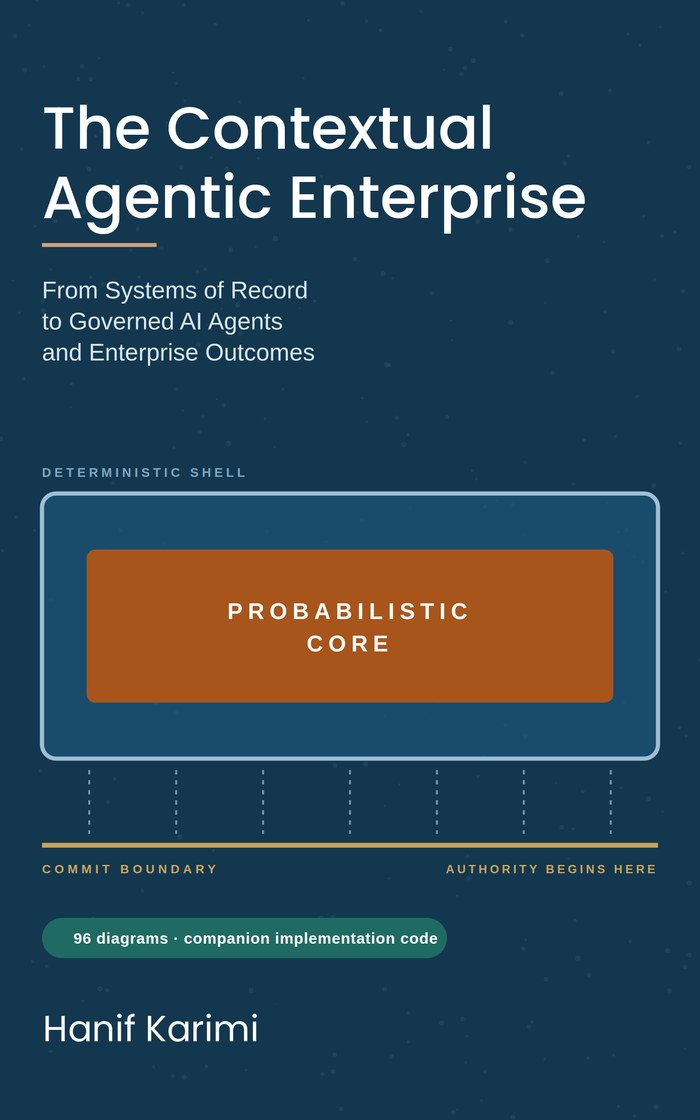
Cover of The Contextual Agentic Enterprise by Hanif Karimi: a probabilistic core inside a deterministic shell, above a line marked Commit Boundary, where authority begins.

Enterprises possess enormous amounts of data, knowledge, process history and technical capability, yet struggle to assemble the right context, evidence and authority at the moment a consequential decision must be made.

Coming soonKindle

The Contextual Agentic Enterprise

From systems of record to governed AI agents and enterprise outcomes

Most enterprise AI programmes stall at the same place. The demonstrations work. The pilot is convincing. Then someone asks what happens when the agent is wrong about a customer's contract, who authorised it to make that…

Read more about the bookRead a sample

The idea in one picture

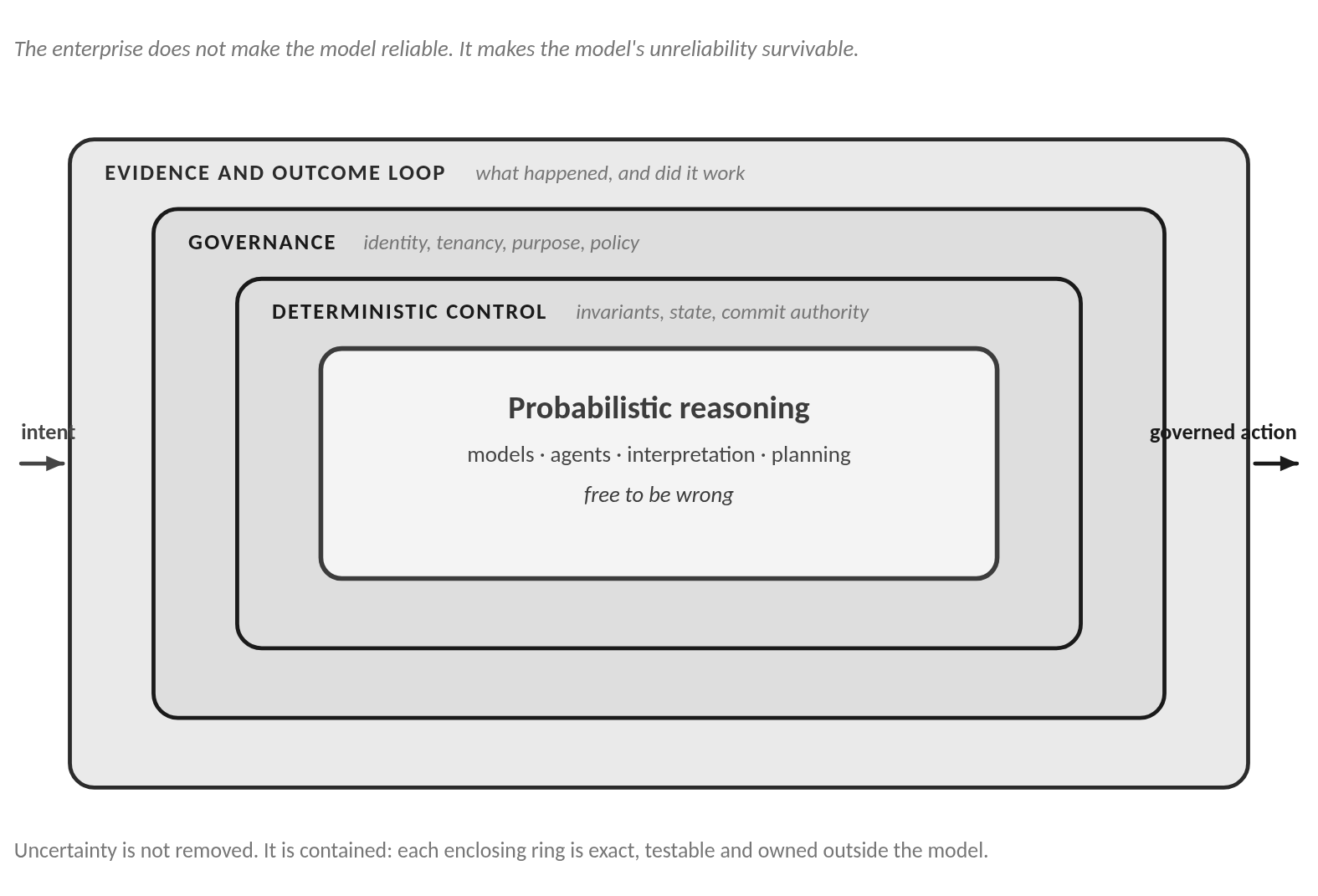
The enterprise does not make the model reliable. It makes the model's unreliability survivable: probabilistic reasoning sits inside deterministic control, governance and an evidence loop, and authority lives only outside the model.

The Contextual Agentic Enterprise encloses probabilistic reasoning within authority, governance, deterministic control and an evidence loop.
Figure 1.3. The Contextual Agentic Enterprise encloses probabilistic reasoning within authority, governance, deterministic control and an evidence loop. From Chapter 1 of the book.

Who this is for

Architects

You have to decide what the agent is allowed to touch, and defend that decision to people who will not accept "the model is usually right" as a control.

Engineering leaders

You own what runs in production. The interesting failures are not hallucinations; they are actions taken with authority nobody meant to grant.

Governance and assurance

You have to review a system whose behaviour varies by design. That is possible, but only if the evidence was designed in rather than reconstructed afterwards.

What you will take away

  • Build a contextual substrate an agent can act on — the organisation's own semantic model, not a pile of retrieved documents.
  • Model authority explicitly, so that what an agent may do is granted, scoped and revocable rather than implied.
  • Put deterministic controls around variable behaviour, instead of waiting for the variation to stop.
  • Produce evidence as a by-product of the work, so an assurance case can be made from what the system already records.
  • Keep human oversight in a place where it can still change the outcome.

Latest

All articles

About the author

I build, learn and write about complex technology systems — and, increasingly, about what it takes to make AI and agents genuinely useful inside an enterprise.

I’ve spent more than 20 years in software engineering, architecture, cloud, identity and large-scale transformation, across more than 100 enterprise projects. These days I build, test and write about agentic systems — and about how to make them genuinely useful in an enterprise while people keep control of authority, evidence and outcomes. Still learning. Still building. Still questioning assumptions.

More about Hanif →

Launch updates

A short note when the book is available, when companion material is released, and when a course opens. Nothing else.

You will receive one message asking you to confirm. Nothing is sent until you do.

What are you interested in?

Marketing consent is never required for companion-code access or support.